What Else Is on My Ballot? A Plain-English Guide to NC’s 2026 Election

Okay… so we already talked about the constitutional amendments.
We already talked about the judges. But if you’ve pulled up your sample ballot, you probably noticed something:
There is a WHOLE lot more on there.
U.S. Senate.
Congress.
NC Senate.
NC House.
District Attorney.
Sheriff.
County commissioners.
School board.
Judges.
Referenda.
And depending on where you live, you may have even more local races. So if you’ve ever looked at your ballot and thought: “Okay… I know who the big names are, but what do all these other people actually do?” This one is for you. And before we get into it, one important thing:
Everybody in North Carolina does NOT have the exact same ballot.
Your ballot depends on where you live including your congressional district, state legislative districts, county, school board district, and any local contests or referenda that apply to you. The North Carolina State Board of Elections lets registered voters pull up their individual sample ballot through the Voter Search tool.
NCSBE So pull yours up.Then let’s walk through it.
U.S. Senate
Let’s start at the federal level. North Carolina has two U.S. senators, but only one of those seats is up for election in 2026. U.S. senators represent the entire state in Washington, D.C.
They are part of Congress and vote on federal laws, federal spending, presidential nominations that require Senate confirmation, treaties, and other national issues.
WOKE Translation:
These are not your “Raleigh politicians. ”They work at the federal level. So when Congress is dealing with things like federal taxes, immigration, Social Security, national defense, federal healthcare policy, or federal education funding… your U.S. senators can be part of those decisions.
U.S. House of Representatives
Congress again. But this time, instead of representing the whole state, your U.S. House member represents a specific congressional district. Next up: North Carolina has 14 U.S. House seats up for election in 2026. NCSBE Members of the U.S. House serve two-year terms.
WOKE Translation:
Your U.S. senator represents North Carolina as a whole. Your U.S. House representative represents your part of North Carolina in Washington. Same federal government. Different job.
NC Senate
Now we’re coming back to Raleigh. The North Carolina Senate is one half of our state legislature: the North Carolina General Assembly. There are 50 state senators, and all 50 seats are up for election in 2026. Senators serve two-year terms. North Carolina General Assembly These are the people who help write and vote on North Carolina laws.
Think:
State taxes
Public education
Healthcare policy
Criminal laws
Voting laws
Transportation
State employee pay
The state budget
And a LOT more.
WOKE Translation:
If Washington passes a federal law. that’s Congress. If Raleigh passes a North Carolina law…your NC General Assembly is involved. And your state senator is part of that.
NC House of Representatives
The other half of the North Carolina General Assembly is the NC House of Representatives. There are 120 members, and all 120 seats are up for election in 2026. Members also serve two-year terms. North Carolina General Assembly. Like state senators, state representatives help write and vote on North Carolina laws and the state budget.
“Wait… NC House and U.S. House are different?”
NC House = Raleigh. Two completely different legislatures. So when you see those races on your ballot, make sure you know which one you’re looking at.
District Attorney
This is one of those races people see and go: “Okay… but what exactly does the DA do?”
The District Attorney is the elected prosecutor for a prosecutorial district. Under North Carolina law, the DA prosecutes criminal cases and infractions that require prosecution in District and Superior Court within that district. North Carolina General Assembly
WOKE Translation:
Law enforcement may investigate a crime and make an arrest. The prosecutor represents the state in the criminal case once it enters the court system.
Different role. Different power.Both matter.
Sheriff
Now THIS is one most people recognize. But the sheriff does more than people sometimes realize.The sheriff is an elected county official. North Carolina law gives sheriffs responsibilities involving criminal and civil justice, court duties, and custody of the county jail. Sheriffs and their deputies also execute certain court papers and legal processes. North Carolina General Assembly
WOKE Translation:
Your sheriff is not the same thing as your city police chief. A police chief is generally appointed to lead a city police department. The sheriff is elected by county voters.
That distinction matters.
County Commissioners
If you’ve been reading WOKE for a while, you already know what I’m about to say:
FOLLOW. THE. MONEY.
County commissioners help govern county operations and approve the county budget. That can affect funding for things like:
Public schools
Sheriff’s departments
Emergency services
Public health
Libraries
Social services
County facilities
And other county programs.
WOKE Translation:
When somebody says:
“Why doesn’t the county spend more money on _____?” County commissioners are one of the places you should look. They don’t control everything. But county budgeting decisions affect a LOT of local services.
School Board
Then we have the school board. Local boards of education oversee and govern their public-school districts within state and federal law. Their responsibilities can include:
Setting district policies
Hiring and evaluating the superintendent
Setting budget priorities
Approving district policies
Overseeing district operations
Making decisions involving facilities, personnel policies, and other school-system matters
North Carolina law gives local boards general control and supervision over matters involving their public-school systems, while superintendents handle the day-to-day administration and carry out board policy. North Carolina School Boards Association
WOKE Translation:
The school board does not control every dollar or every education rule. Some school funding comes from the state. Some comes from the federal government. Counties provide local funding. And the school district has its own responsibilities. Which is exactly why I keep saying:
Local government is a group project.
And yes, we need a whole separate blog on who actually pays for our schools.
Judges
If you read my last blog, you already know where I’m going with this one. North Carolina voters will see one Supreme Court race and three Court of Appeals races statewide in the 2026 general election. The NC Supreme Court is the state’s highest court. The Court of Appeals reviews cases from lower courts and certain administrative agencies. If you missed that breakdown, go read:
Other Local Offices
This is where your ballot may look different from somebody else’s. Depending on where you live, you may also see races involving:
District or Superior Court judges
Clerk of Superior Court
Soil and Water Conservation District supervisors
Municipal offices
Other county offices
Local referenda
The exact contests depend on your jurisdiction. NCSBE says the 2026 election includes local judges, district attorneys, sheriffs, county commissioners, boards of education, and municipal contests in some jurisdictions. Which is why somebody in Wilson County may not have the exact same ballot as somebody in Pitt County. Or Wake County. Or Mecklenburg County.
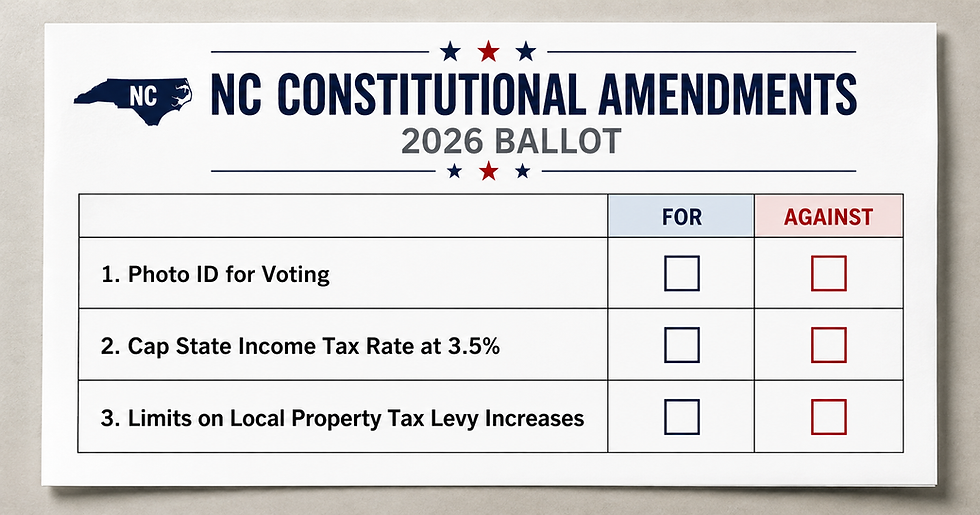
And Then There Are the Constitutional Amendments
Yep. After ALL of that… we still have the constitutional amendments. North Carolina voters have statewide referendum questions on the 2026 ballot. NCSBE publishes the official referendum lists and sample ballots. And if you already read my breakdown:
What’s Actually on My Ballot? NC’s 2026 Constitutional Amendments Explained
then you already know the deal. If not…go read that BEFORE you vote.
Because FOR and AGAINST look real simple until you actually start reading what the amendment would change.
So How Do I Know What’s Actually on MY Ballot?
This might be the most important part of this entire post. Look at your sample ballot before Election Day. The North Carolina State Board of Elections says registered voters can find their individual sample ballot by using the Voter Search tool, clicking their voter record, and scrolling to “Your Sample Ballot.” NCSBE And please don’t just open it. Actually READ it. Look up the names you don’t recognize. Look up the offices you don’t understand. Read the referendum questions. Make your decisions before you’re standing at the voting machine trying to remember somebody’s name.
While We’re Here: When Is Election Day?
The 2026 general election is:
Tuesday, November 3, 2026.
On Election Day, North Carolina polls are open from 6:30 a.m. until 7:30 p.m.
If you are in line at your assigned polling place by 7:30 p.m., you are allowed to vote. NCSBE
North Carolina also has:
In-person early voting: October 15–31
Mail-in absentee voting
And any registered North Carolina voter may request a mail-in absentee ballot; no excuse is required. NCSBE So you have options. Use the voting method that works for you.
The Bottom Line
Your ballot is more than the biggest race everybody is talking about.
It’s federal government.
State government.
County government.
Schools.
Courts.
Local leadership.
And constitutional questions.
Some of those names may be familiar. Some won’t be. But every office has a job. And before we choose the person for the job…we should probably know what the job actually is. Pull up your sample ballot. Research the offices. Research the candidates. Read the questions. Then make your own decisions. Because knowing what’s on your ballot is just as important as knowing who’s on it.
Stay informed. Stay engaged. Stay WOKE.

Comments